ARTIST TALK
Julia Haugeneder in conversation with Lisa Ortner-Kreil
Thu 3 Dec, 18:00
In the conventional sense, the Vienna-based artist Julia Haugeneder would have to be called a sculptor. Her preferred material is bookbinding glue, which she casts, layers and folds into peculiar packages – hence the title of many of her works: Faltungen (Foldings). One may think of Gilles Deleuze, for whom the fold is the basic figure of a thinking that knows no inside without an outside. And yet the label sculptor falls short, for Haugeneder is above all a storyteller. Her medium is not so much language as the material itself, along with the actions through which she works it. Which materials and actions shape our surroundings, and which memories remain hidden within them? This materialist question also runs through her fourth solo exhibition at Galerie Elisabeth & Klaus Thoman. Language nonetheless remains a formal device. In Anglo-American sport, crunch time refers to the final, decisive phase of a game (in basketball, for instance). Taken literally, however, crunch also evokes cracking, grinding and crushing: a pressure point at which something profoundly transformative sets in. Where the rubber hits the road, in turn – an idiom traced back to a tyre advertisement from the 1960s – denotes the moment when theory meets the asphalt of practice. Haugeneder recently showed some of the works at Sexauer Gallery in Berlin under an almost identical title: The Crunchtime – Where the Rubber Hits the Road. Almost, because there the title was not only set in English title case but also in the present tense. This difference is not a mistake but a method: the shared main title links the two exhibitions, while the shift from hits to hit marks a temporal displacement. Is it already too late? The story told is one of coexistence – not only among human beings, but between humans and nature – of how we treat the environment in the face of the climate catastrophe and, not least, of capitalism. In doing so, Haugeneder builds the very bridge that the French philosopher Michel Serres called for in his now-classic essay The Natural Contract (1990): from the merely mundane, the world of humans among themselves, to the mundial, the world as a whole1, with which a new contract has yet to be concluded. The art-historical point of departure is a drawing by Pieter Bruegel the Elder in the Albertina: Big Fish Eat Little Fish (1556) – an early critique of capitalism, if you will, and at the same time an image of that (necessary?) metabolism to which all earthly life is subject. Right at the entrance, three blue-framed panels arranged horizontally one above the other greet visitors like a display. They are not flush but offset from one another in steps: not static objects but moving, narrative images. In copper-brown bookbinding glue (cast using linocut), specific details from Bruegel’s drawing recur in shifted arrangements and changing perspectives.
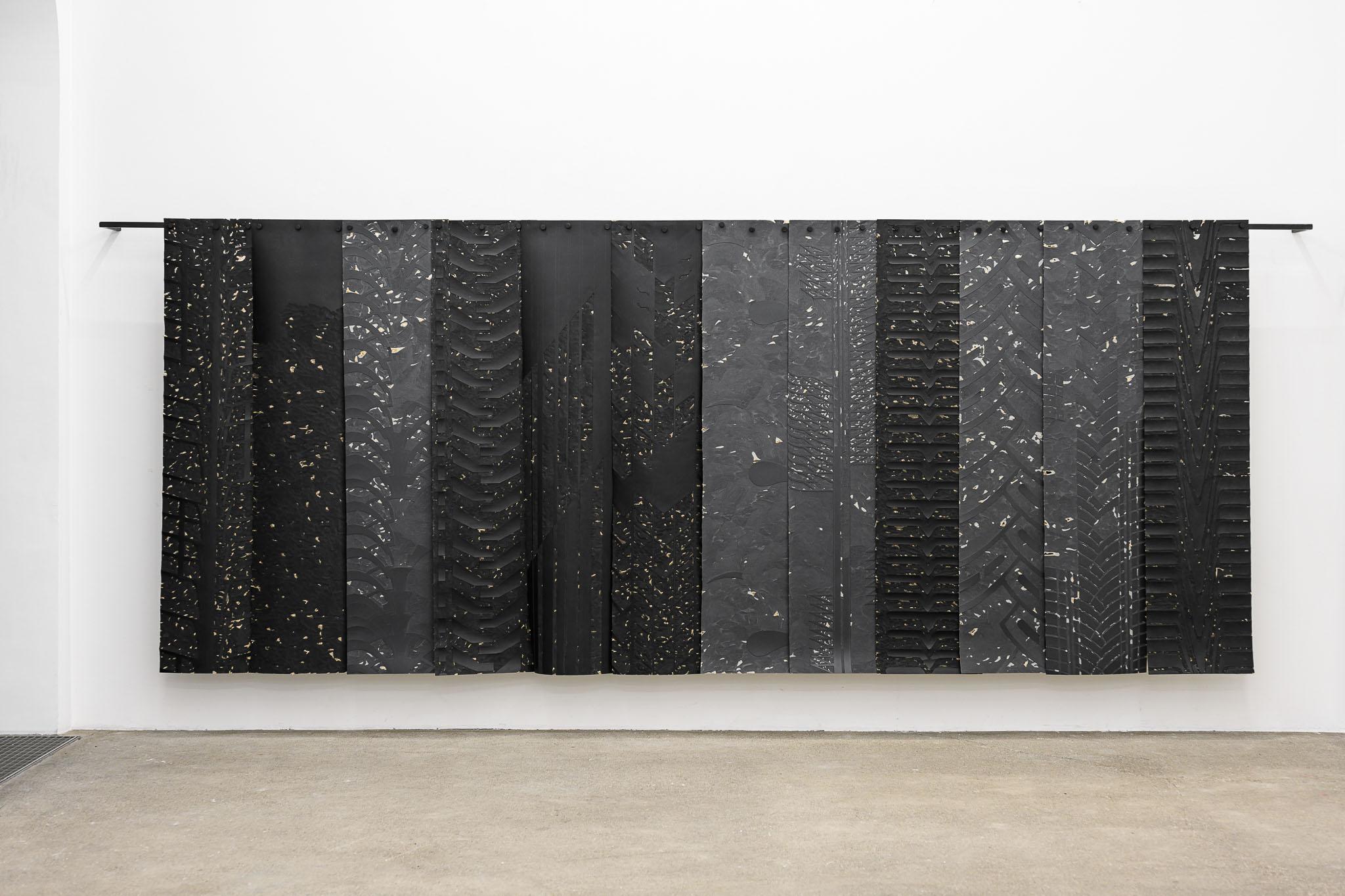
The title ewige Wiederkehr (eternal recurrence) invokes the thought that Nietzsche, in The Gay Science, called “the heaviest weight”2: that everything that is will return countless times. In Haugeneder’s work, of course, it never returns quite the same – repetition produces difference. In the next room, a structure that is hard to classify hangs on a chain from the ceiling to just above the floor. Assembled from stacked, tied-up glue packages in shades of brown, green and silver, the sculpture Nimrod overwhelms with associations: cocoon, bundle of buds, caterpillar – or an inverted tree rooted in the ceiling. The title calls up the biblical “mighty hunter”, whose name is derived from marad (“to rebel”) and whom tradition makes the builder of the Tower of Babel – a motif that Bruegel, in turn, depicted in 1563 in one of his most famous paintings. In American English, by contrast, nimrod became – supposedly thanks to Bugs Bunny – an ironic term for an idiot. And finally, Nimrod is a Green Day album (1997) about growing up and not belonging – and, once again, about rebellion. Anyone hoping for a single reading here will, so to speak, come unstuck. Around this world tree, floral elements are distributed across the walls: curved leaf and cloud forms, half ceramic, half bookbinding glue, interlocking like displaced puzzle pieces. Some come loose like leaves falling from a tree. Their title, weder Bindung noch Bündnis (neither bond nor alliance), is borrowed from Serres’ reflections on love3 – and there is a certain wit in the fact that these forms are held together by a binding agent, of all things. In the rear room, three green banners reminiscent of skins refer explicitly to The Natural Contract; Bruegel’s fish reappear on them, as if on the flags of an alliance yet to be founded. A slender, freely suspended stele in the same blue as the panels at the entrance – a link between above and below – takes up the floral motif once more and brings to mind Gustav Klimt’s Tree of Life from the Stoclet Frieze. The ornament proves to be the decisive gesture: an imprint of the ever-same that is nonetheless never identical. Scattered across the floor, Haugeneder is showing pure ceramics for the first time: small, delicate objects reminiscent of cracked eggs or shells, which, as microcosms, point to the macro level of our planetary existence. They rest not on plinths but on flat technical devices made of grey perforated sheet metal, whose metallic coldness counters the warm fragility of the objects. Their title, Crunchtime, seems to anticipate the moment of shattering – and yet they stubbornly endure, distributed through the space as literal stumbling points. At the end, the presentation, held in shades of green, brown and copper, breaks off at a large black work that occupies the end wall like a curtain. Here the advertising slogan reappears: tyre treads emerge on the hanging lengths of black linocut, interspersed with bright speckles like grit on asphalt or stars in the night sky – one thinks of Robert Rauschenberg and John Cage’s Automobile Tire Print (1953), here, however, as an index of what has already rolled over us. Does the exhibition thus tip over into dystopia? Or does it look optimistically towards a world in which a new alliance between humans and nature reconciles us with the planet? The Crunchtime is, as the title suggests, a wake-up call – and thus an invitation to think along, to take part, or at least to acknowledge what is at stake.
Text: Elias Schöpf
Julia Haugeneder (b. 1987 in Vienna) studied graphic arts and printmaking at the Academy of Fine Arts Vienna and at Central Saint Martins, UAL, in London. She also completed degrees in art history as well as in philosophy and theatre, film and media studies. Her work has been shown in Austria and abroad, including at Kunstverein Augsburg (GER), Neuer Kunstverein Wien (AT), NÖDOK St. Pölten (AT), Museum Liaunig (AT), DOK Niederösterreich (AT), Landesgalerie Krems (AT), Museum der Moderne Salzburg (AT), Post-Zentrale Wien (AT), new now art space Frankfurt (GER), 5020 Salzburg (AT), Kunstverein Baden (AT), Galerie Elisabeth & Klaus Thoman Innsbruck (AT), Galerie
Sophia Vonier (AT), MUSA Wien (AT) and xposit Wien (AT). In 2020 she was nominated for the Austrian Dagmar Chobot Sculpture Prize. Her work is held in numerous private and public collections in Austria, including the Academy of Fine Arts Vienna, Museum Liaunig, Museum der Moderne Salzburg, the Artothek and Federal Collection (Artothek und Sammlung des Bundes), the City of Vienna Collection, Österreichische Post, Oesterreichische Nationalbank, Tiroler Landesmuseum Ferdinandeum, Sammlung Niederösterreich, Sammlung Liesenfeld and Vienna Insurance Group.
Julia Haugeneder has been represented by Galerie Elisabeth & Klaus Thoman, Innsbruck/Vienna (AT), since 2021. In March 2027, the Landesgalerie Niederösterreich in Krems will present a solo exhibition by Julia Haugeneder, curated by Lisa Ortner-Kreil.
Julia Haugeneder and Galerie Elisabeth & Klaus Thoman would like to thank Julian Fischbach, Tamara Wollny, Lucas Schmid and Jana Hochdorfer for their dedicated support in installing the exhibition.
_________________________________________
1 Cf. Michel Serres, Der Naturvertrag [transl. from the French by Hans Horst-Henschen], Frankfurt am Main 20152, pp. 27f.
2 Friedrich Nietzsche, Die fröhliche Wissenschaft, in: id., Sämtliche Werke. Kritische Studienausgabe in 15 Bänden, vol. 3, ed. Giorgio Colli and Mazzino Montinari, Munichm 1999², p. 570 (aph. 341).
3 Cf. Serres 20152 (see note 1), pp. 84f.